

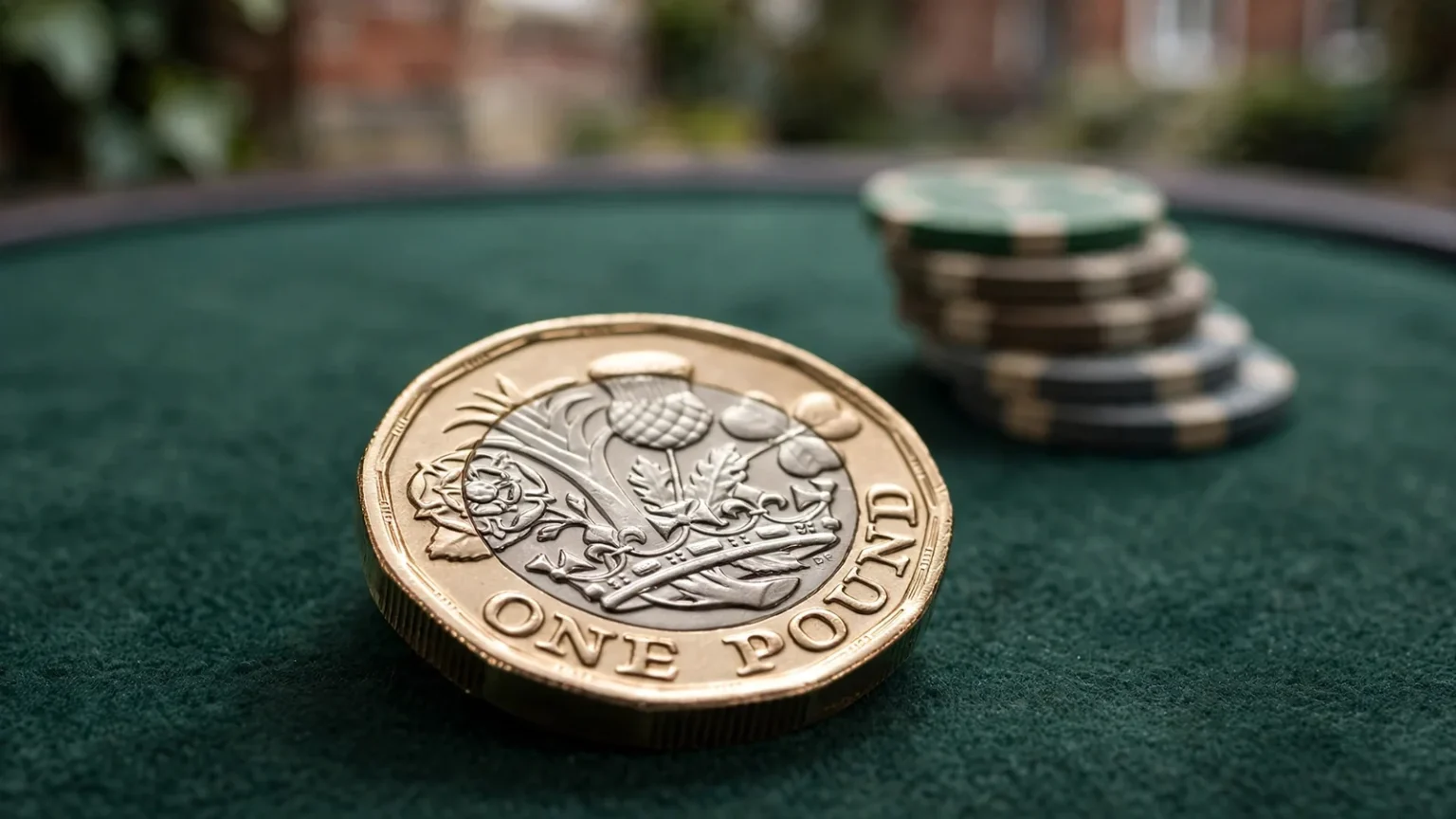
A one-pound cashier threshold confirms the amount accepted, but not which games, payment methods or account features are available.
What a £1 Minimum Deposit Means in Practice
A £1 minimum deposit is a specific cashier threshold: the account can be funded with a payment of one pound, subject to the operator’s stated terms. Some UK casinos accept deposits at that level. The claim is narrower than saying a casino is “low-cost”, which may refer to other features and does not establish the amount the cashier will accept.
That distinction matters because promotional descriptions can blur separate conditions. A site might advertise small-stake play or describe itself as suitable for a modest budget, yet still require more than £1 to open a real-money balance. Conversely, a cashier that accepts £1 establishes only that the deposit threshold is available. It does not, by itself, show what the account can access or how practical it is to use.
The clearest evidence is therefore a stated minimum in the cashier or the operator’s terms, rather than a general label or headline. The amount should be read as the minimum for the relevant account and payment route, not automatically as a promise that every method will accept the same sum. A displayed threshold can also be subject to account-specific conditions. Where the terms and the cashier do not match, the claim should not be treated as confirmed without clarification from the operator.
A specialist casino review reported that it had verified six UK Gambling Commission-licensed casinos accepting a genuine £1 minimum deposit. That finding is useful as a dated snapshot, not as a permanent census of the market: cashier settings and operator terms can change. The same review identified NetBet as the only UKGC-listed casino on its list with a £1 cashier minimum. This is a bounded statement about that review’s findings; it does not establish that NetBet is the only licensed operator to have offered the threshold at any time, or that its cashier still displays it.
The word “genuine” is important in this context. A £1 figure may refer to the amount accepted into the casino balance, rather than a promotional claim about how little it costs to begin playing. It should also be distinguished from an amount that is available only under a particular condition or through a particular route. The threshold is meaningful only when it describes the actual minimum required by the cashier for a deposit.
A reliable assessment of a £1 minimum deposit casino consequently separates three questions. First, does the operator serve the UK market under the relevant Gambling Commission licence? Second, does the cashier currently permit a deposit of £1 on the account in question? Third, does the advertised figure describe the required deposit itself, rather than another feature of the site? These checks define what the claim means without turning it into a broader endorsement.
The licence point is not interchangeable with the deposit point. Operators offering real-money gambling to customers in Great Britain must hold the relevant UK Gambling Commission licence, regardless of where the business is based. A low cashier minimum is not evidence of regulatory status, and regulatory status does not prove that a particular cashier accepts £1. Each claim needs its own support.
No Minimum Deposit Casinos in the UK: What £1 Means
For readers comparing minimum deposit casinos, the practical value of the £1 label is thus limited but clear: it identifies a low entry threshold where that threshold is genuinely available. It does not establish that the casino is inexpensive in every other respect, that the same minimum applies to every account, or that the figure will remain unchanged. Nor does the existence of a review count prove that every operator on its list is still offering the same cashier setting.
Careful wording is especially important when a list is presented as “the best” £1 minimum deposit casinos. A low threshold alone cannot support a ranking, and a review’s finite set of checked operators cannot be treated as a complete market inventory. The available review finding can identify examples, including NetBet as the sole casino in that particular list reported with the £1 cashier minimum, but it does not provide a sound basis for a broader ranking. A claim about a named operator should therefore be tied to the specific evidence and its scope.
A £1 minimum deposit describes the smallest amount a cashier is reported to accept; it is not a general guarantee of the site’s overall cost or suitability.
In practice, the phrase “£1 minimum deposit” should be read literally and narrowly. It describes the smallest deposit the cashier is reported to accept, not the overall cost or suitability of an account. Where the claim is not confirmed at the cashier or in current operator terms, “low deposit” is only a general description, not proof of a £1 threshold.
How £1 Sits Alongside Other Minimum Deposit Tiers
A £1 cashier minimum sits at the bottom of the deposit range described for UK casinos, but it is not representative of the thresholds reported for most payment arrangements. A specialist casino review identifies £1 as a rare entry point, with access at that level commonly associated with particular methods such as Boku or Payforit mobile billing. The distinction matters: a casino may advertise a low minimum deposit without accepting £1 through every option in its cashier.
The deposit threshold is set by the operator and can depend on how the transaction is made. A £1 figure should therefore be read as a specific cashier condition, not as a general description of every way to fund an account. If the cashier shows a different minimum beside direct banking, a card or another method, that method-specific figure is the relevant one. The presence of a £1 option does not establish that all payment routes share it.
Direct banking provides a useful comparison. A specialist review describes £10 as the typical minimum deposit among UK casinos that accept this method, while recording operators with thresholds of £5 or £20. These are reported examples rather than a fixed rule for the market, and a particular operator’s current cashier may differ. Still, the comparison shows why a £1 threshold should not be assumed to apply to direct banking merely because it is available through another route.
£5 Minimum Deposit Casinos in the UK: What to Know
The spread between those reported direct-banking thresholds also cautions against treating a single figure as universal. One casino may set a lower entry point, while another may require a larger amount for the same broad payment category. The cashier minimum is an operator-level condition, and the payment option selected can determine which condition appears. This is why comparisons between minimum-deposit casinos are meaningful only when they specify both the operator and the route being assessed.
A £1 minimum deposit casino may therefore be best understood as a narrow threshold rather than a whole-site promise. The central question is not simply whether a casino accepts a pound, but whether the £1 figure applies to the payment method intended for use. Where the lowest tier is linked to mobile billing, the cashier can present a different threshold for direct banking. The lowest advertised amount and the lowest available amount for every payment method are not necessarily the same.
This distinction also helps make sense of descriptions such as “low minimum deposit”. That wording alone does not identify the actual amount or establish which payment methods qualify. A precise comparison needs the cashier minimum, the eligible payment route and any difference between routes. Without those details, a broad label can make a higher threshold look equivalent to a confirmed £1 option when the two are not.
The available specialist review describes £1 as the lowest deposit tier and characterises it as rare, with the figure generally tied to selected methods such as Boku or Payforit. That is a useful indication of how the tier is structured, but it should not be turned into a claim that every casino offers those methods or that either one is available at every operator. Nor does a single reported threshold establish that the same condition will remain in place over time.
Mobile Billing
Commonly associated with the rare £1 entry point, specifically via methods such as Boku or Payforit.
Direct Banking
Typically involves higher thresholds, with £10 described as typical, though variations of £5 or £20 exist.
Method-Specific Rules
The deposit threshold is set by the operator and can vary depending on the payment route selected.
For direct banking, the review’s £5, £10 and £20 examples show that the ordinary comparison is not simply between £1 and one standard amount. There is variation even among casinos that accept the same broad method. A deposit threshold is consequently best checked at the point where the cashier lists the available routes, rather than inferred from a casino’s general description or from an amount reported for another operator.
The practical comparison is between a rare £1 entry point, often connected with a specific payment route, and higher direct-banking thresholds reported by a specialist review. The difference is not evidence that one casino is safer or more legitimate than another; the deposit amount alone does not establish regulatory status. In Great Britain, a real-money operator serving customers must hold the relevant Gambling Commission licence. The cashier figure and the operator’s licensing position are separate matters, and neither should be used as a substitute for checking the other.
Accordingly, “£1 minimum” is most informative when treated as a method-specific cashier figure. Direct banking is reported at higher thresholds, with £10 described as typical in the specialist review and £5 or £20 appearing as variations. Those figures help frame the range, but they do not guarantee the amount available at any particular casino. A genuine comparison keeps the payment route attached to the quoted minimum and avoids presenting a rare lowest tier as the standard across UK casinos.
£20 Minimum Deposit Casinos in the UK
Top online casinos in the UK
- SpinFormulaBonus: 550% Up To £15,000 + 550 FS · Payout speed: 1-3 business days
- AmunbetBonus: Join now and get 450% up to 2,700 GBP + 450 FS · Payout speed: 1-3 business days
- NightWinBonus: £900 + 400 free spins · Payout speed: 1-3 business days
- NightLuckBonus: Welcome Pack + 805% Up To 6400€ + 280 FS · Payout speed: 1-3 business days
- DieselwinBonus: Welcome Pack 250% up to £4000 + 200 FS · Payout speed: 1-3 business days
- BritsinoBonus: Welcome Package – Get your £2,200 + 2,000 FS · Payout speed: 1-3 business days
- WinBeastBonus: €5000 + 500 FS + €650 Freebet · Payout speed: 1-3 business days
- EvoSpinBonus: 125% up to €2500 + 125 Free Spins · Payout speed: 1-3 business days
- JetsetspinsBonus: 200% Bonus + 100 Free Spins + Free Royal Wheel · Payout speed: 1-3 business days
- BeOnBetBonus: 100% up to €500 + 100 FS · Payout speed: 1-3 business days
What a £1 Deposit Does—and Does Not—Unlock
A successful £1 deposit places funds in the casino account, but it does not necessarily activate every feature associated with a new account. The cashier minimum, the qualifying amount for a welcome offer and the minimum amount that can be withdrawn are separate conditions. Treating them as one figure can make a small deposit appear to provide access that the offer terms or withdrawal rules do not provide.
The distinction matters because a low cashier minimum describes what the operator will accept, not what it will match with a promotion. A specialist review puts common welcome-offer deposit requirements in the £5 to £10 range. On that basis, a £1 payment may be accepted as a deposit while remaining below the qualifying threshold for an advertised deal. The account can therefore contain cash without the player receiving bonus funds or promotional spins.
This does not establish that every casino rejects a £1 deposit for promotional purposes. Offer conditions are operator-specific, and the relevant wording is the minimum qualifying deposit attached to the particular promotion. Where a deal requires a larger deposit, making a smaller payment does not meet that condition merely because the cashier has accepted it. The offer may also have separate eligibility terms, so the displayed headline alone is not enough to determine whether the deposit qualifies.
A specialist review also reports that some UK casinos exclude the £1 deposit bracket from welcome promotions. That is a qualification about certain offers, not a universal rule for all UK casinos. The practical point is that “£1 minimum deposit” and “£1 deposit eligible for a welcome offer” make different claims. The first concerns funding the account; the second concerns a promotion’s terms.
A £1 deposit may be accepted by the cashier while remaining below the qualifying threshold for welcome offers or the minimum amount required for withdrawals.
The same separation applies when taking money out. A deposit of £1 does not, by itself, show that the casino will process a withdrawal of £1. A specialist review gives withdrawal minimums of £10 to £20 at many UK casinos. Those thresholds can be above the initial deposit, meaning that a small balance may not yet meet the stated cash-out requirement. The figure describes what that type of review reports, not a fixed rule applying to every operator.
A withdrawal threshold should not be confused with a loss of the balance. It specifies the amount required for a withdrawal request under the operator’s terms; it does not mean that the account’s funds automatically become withdrawable at that level, nor does it explain how a particular account balance was acquired. The rules for cashing out need to be considered independently from the amount accepted at deposit.
There are therefore several possible outcomes after a £1 payment. The funds may be credited without a welcome offer; the offer may be unavailable because its qualifying deposit is higher; or the balance may fall below the casino’s stated withdrawal minimum. These conditions can coexist. A site can accept the deposit and still impose separate limits on promotional eligibility and withdrawals.
This is why a small cashier minimum should not be read as evidence that the full account experience is available for the same amount. It establishes only that the initial payment can be accepted at that level. Promotion terms determine whether an offer applies, while withdrawal terms determine the amount required to request a cash-out. Neither condition can be inferred from the cashier minimum alone.
£2 Minimum Deposit Casinos in the UK: What to Know
For a £1 minimum deposit casino in the UK, the relevant distinction is between access to the account and access to its associated benefits. A deposit may fund the account while leaving a welcome deal inactive and the balance below a withdrawal threshold. These are not contradictions: each rule governs a different stage of the transaction.
The clearest reading of an offer is therefore its qualifying-deposit condition, rather than the general promotional headline. The clearest reading of a cash-out rule is the operator’s stated minimum withdrawal, rather than the amount accepted by the cashier. Without those separate terms, the £1 figure gives only a narrow answer: it may describe the entry point for depositing, but it does not establish promotional eligibility or the amount needed to withdraw.
Online Casino Payments That Can Support Small Deposits
A £1 cashier minimum is not necessarily available through every payment option shown in a casino account. The amount a customer can deposit may depend on the operator’s rules for that method, even when the account itself is described as accepting a small deposit. For someone looking for an online casino with a £1 minimum deposit in the UK, the relevant detail is therefore the minimum displayed for the selected payment route, not simply the lowest figure mentioned elsewhere.
At a given UK operator, the cashier minimum is generally the same across its payment methods. There are exceptions: some casinos set a higher minimum for direct banking than for debit cards or e-wallets. This means that a £1 threshold, where offered, may apply to only some routes. A payment method’s availability does not by itself establish that it can be used to deposit that amount.
Do
- Verify the minimum displayed for the specific payment route
- Use debit cards, bank accounts, or debit-funded e-wallets
Don’t
- Assume a £1 threshold applies to all payment methods
- Attempt to use credit cards for gambling deposits
Visa and Mastercard debit cards are accepted at almost all UK casinos and support low minimum deposits. They are therefore among the payment types relevant to small transactions. However, broad acceptance of a card brand does not determine an individual casino’s cashier minimum. The amount permitted remains subject to that operator’s terms for the card payment, and a small threshold should not be inferred from the logo alone.
Direct banking follows the same general principle: the operator’s cashier sets the conditions for the method. A casino may align its direct-banking minimum with its card or e-wallet minimum, or impose a higher threshold for bank transfers. Where the higher threshold applies, a £1 deposit might remain possible through another supported method but not through direct banking. The distinction is between an account-level minimum and the minimum attached to a particular payment route.
The UK’s restrictions on funding gambling accounts also define which payment sources are permitted. Following the UK Gambling Commission’s 2020 ban on credit-card gambling, deposits must come from debit cards, bank accounts or e-wallets funded by debit. A credit card cannot be used as a gambling deposit method. This restriction concerns the source of funds, not whether an operator offers a £1 cashier minimum.
An e-wallet is not automatically suitable merely because it appears in a casino’s payment menu. Under the stated rules, it must be funded by debit for gambling deposits. The payment route must also meet the casino’s own minimum. Consequently, a low cashier threshold and an allowed source of funds are separate conditions: both have to apply for a small deposit to go through.
£3 Minimum Deposit Casinos in the UK: What to Know
These distinctions matter when a casino advertises a minimum deposit without identifying the method to which it applies. The figure may describe the lowest amount accepted through at least one route rather than every route available. Conversely, a casino’s higher direct-banking threshold does not establish that all its payment methods require the same amount. The cashier’s displayed conditions are the more precise basis for understanding what can be deposited by each method.
For a £1 transaction, the practical sequence is straightforward: the chosen method must be permitted for gambling, the operator must support it, and its cashier minimum must not exceed the intended deposit. These conditions should not be collapsed into a single claim that a casino “accepts £1”. Such a claim can obscure whether the amount applies to a debit card, an eligible e-wallet or direct banking.
The distinction also prevents a common misunderstanding about credit cards. A card logo or familiar payment option does not mean that every card product is eligible. Debit cards are within the permitted category; credit-card gambling deposits are not. E-wallet funding is likewise subject to the source-of-funds restriction. A small deposit is not an exception to these requirements.
Overall, payment method can affect whether a £1 deposit is available, but it does not follow that every operator assigns a different minimum to every method. Most apply a shared minimum across the cashier, while some specify a higher amount for direct banking than for cards or e-wallets. The precise combination varies by operator, so the relevant question is not only whether a casino states a £1 minimum, but which permitted payment method carries that threshold.
Payment Source Restrictions
Following the UK Gambling Commission’s 2020 ban, deposits must come from debit cards, bank accounts, or e-wallets funded by debit. Credit cards are not permitted as a gambling deposit method.
Playing Slots for Real Money After a £1 Deposit
A £1 minimum deposit establishes the amount that can enter an account; it does not determine how long that balance will last in play. For real-money slots, the relevant figure is the stake selected for each spin. Many slots accept stakes starting between £0.10 and £0.20 per spin, so a pound can fund several spins at those lower settings, provided the chosen game and account allow them.
That distinction matters when assessing a £1 minimum deposit online casino. A low cashier threshold makes a small balance possible, but it does not make the balance substantial. Each spin deducts its stake, and winnings may change the available balance; the amount remaining therefore depends on the stakes and outcomes. A £1 deposit can be used for real-money play, but it offers limited room for repeated spins if the stake is near the upper end of the stated range.
The same applies on a mobile casino. The device does not alter the relationship between a stake and the balance: a spin still draws from the funds available in the account. A player looking for a real-money £1 minimum deposit casino should therefore separate two questions: whether the cashier accepts a pound, and whether the games offer stakes that suit that balance. The stated stake range provides one useful reference point, but it does not establish the minimum stake for every slot.
Cash-out conditions are a separate constraint. A balance can be available for play without being withdrawable in full if the operator’s minimum withdrawal is higher than the amount in the account. A specialist casino review reported minimum withdrawal thresholds from £1 to £5 for the operators it examined. That is a finding from a particular review, not a reliable market-wide rule, and withdrawal conditions can vary by casino.
£4 Minimum Deposit Casinos in the UK Explained
This makes the cashier minimum only one part of the practical calculation. A £1 deposit may be enough to begin playing a slot with a low permitted stake, yet a remaining balance could fall below the withdrawal threshold set for that account. Conversely, the reported lower end of the review’s range shows that some terms may allow a small balance to be cashed out. The applicable cashier and withdrawal rules need to be read separately; a low deposit threshold does not itself confirm a matching cash-out threshold.
In short, a £1 minimum deposit can provide access to real-money slot play, but it should not be treated as a measure of play duration or withdrawability. Stake size governs how quickly the balance is used, while the casino’s withdrawal terms govern whether any remaining amount can be cashed out.
What £1 Deposits Reveal About Gamstop Status
A £1 cashier minimum describes the amount an operator allows to be deposited; it does not establish whether that operator is connected to GamStop. The deposit threshold and a casino’s status in relation to the self-exclusion scheme are separate matters. Neither can be inferred from the other.
This distinction matters when assessing claims that a UK casino accepting a £1 deposit is “not on GamStop”. That wording may describe an operator’s relationship with the scheme, but the low minimum itself provides no evidence for the claim. Equally, a casino’s participation in GamStop cannot be established from its cashier settings. Statements about a particular site therefore require operator-level confirmation rather than assumptions based on its deposit options.
Licensing and GamStop
A low deposit threshold is not proof of a UK Gambling Commission licence, nor does it establish whether an operator is connected to GamStop.
GamStop status should also not be confused with legal authorisation. Remote operators serving customers in Great Britain must hold the relevant UK Gambling Commission licence. A low deposit threshold is not proof of a licence, and a claim about GamStop does not substitute for checking whether an operator is authorised to serve the market. These are distinct questions, and each needs to be considered on its own terms.
The same caution applies to searches for £1 minimum deposit slot sites in the UK. A site’s ability to accept a small payment reveals nothing about its self-exclusion arrangements or regulatory standing. Without reliable, current confirmation for an individual operator, a categorical label such as “on GamStop” or “not on GamStop” should not be treated as established.
The age requirement is clearer: online gambling in the UK is restricted to people aged 18 and over. A low cashier minimum does not alter that condition or make an account suitable for someone below the legal age. Deposit size, age eligibility, licensing and GamStop status are separate considerations; only the first is described by a £1 minimum.
PayPal, Small Transactions and the Cost of Depositing
A £1 cashier minimum and the cost of making a payment are separate matters. PayPal may appear among a casino’s payment options, but its presence alone does not establish that a £1 transaction will be accepted. The amount allowed can depend on the terms shown for that payment route and account, so the cashier’s stated minimum is the relevant figure when assessing a small deposit.
Pay-by-phone casinos in the UK: deposits and rules
A flat transaction fee can also change the effective cost. One specialist review reported fees of £1 to £3 charged by some payment providers. That is not a fee that can be assumed to apply to PayPal or to every casino transaction; it is a reported possibility, and the charge depends on the provider’s terms. Where a fee does apply, it is separate from the sum credited to the casino account.
The arithmetic matters particularly at the lowest deposit level. A £1 fee added to a £1 deposit would make the payment cost £2, before considering whether any other charges apply. A fee of £3 would make the same deposit cost £4. These calculations illustrate the effect of the reported fee range; they do not describe a standard PayPal charge or a guaranteed casino payment cost.
For a small-deposit casino, the useful distinction is therefore between the amount the cashier accepts and the amount ultimately debited or charged by the payment service. A £1 minimum does not itself confirm that PayPal supports a deposit at that level, nor that the transaction will be fee-free. The applicable payment terms should be read alongside the cashier minimum, with any provider charge treated as an additional cost rather than part of the casino balance.
Low Deposits and Responsible Gambling Controls
A low cashier minimum does not remove the safeguards that apply to gambling accounts in Britain. Players must be at least 18, and an operator must verify a customer’s age before permitting a deposit. The size of the first payment does not create an exception to that requirement.
There is also a financial-control step before a new customer’s first deposit: the operator must prompt them to set a financial limit. This places a decision about account spending before funds are added, rather than treating a small initial deposit as a substitute for setting a boundary. The requirement applies whether the starting balance is modest or larger.
UK operators must prompt new customers to set a financial limit before their first deposit, regardless of whether the starting balance is small or large.
Account-level limit controls must remain accessible after registration. They provide a way to manage financial boundaries within the account, although the existence of a control does not establish that a particular limit is suitable for every person. A low minimum deposit is therefore only a feature of the cashier; it says nothing by itself about the wider controls available or the account holder’s circumstances.
These measures sit within the UK framework for licensed remote gambling. A low-deposit casino serving the British market must meet the relevant operating requirements, including age verification and the prompt to set a financial limit before the first deposit. The threshold for depositing and the safeguards around gambling are separate questions: reducing the amount needed to open play does not lower the age requirement or remove the need for financial controls.
Why a £1 Deposit May Not Mean a £1 Payment
A casino’s cashier minimum and the amount needed to buy a payment product are separate figures. A site may accept a £1 deposit without offering a way to purchase exactly £1 of prepaid credit. Paysafecard illustrates this distinction: its vouchers are sold in set denominations of £5, £10, £25, £50 and £100.
A voucher can nevertheless fund several smaller deposits. If the casino accepts £1 deposits through Paysafecard, part of the voucher balance can be used at a time, subject to the payment flow and the remaining funds. The amount paid for the voucher is therefore not necessarily the amount credited to the casino account in one transaction.
This matters when interpreting claims about a £1 minimum deposit casino in the UK. The claim concerns the smallest permitted cashier transaction, not necessarily the smallest purchase required to obtain a usable payment method. A £5 voucher, for instance, could support separate £1 deposits rather than a single deposit of its full value.
Online Casinos That Accept SMS Deposits: Boku Guide
The distinction also affects how “paying £1” is understood. It may describe the value transferred to the gambling account, while the initial outlay for the payment product is higher. Remaining voucher credit is not the same as money already deposited, and it should not be treated as though the casino has received the whole voucher amount.
The practical position depends on whether the cashier accepts the chosen voucher and permits the intended transaction size. Voucher denominations alone do not establish a casino’s cashier minimum; that threshold is set separately by the operator.
Bonus Eligibility When a Casino Accepts £1
A £1 cashier minimum does not, by itself, establish eligibility for a welcome offer. The casino’s promotion terms determine whether a deposit qualifies, and a payment that can be accepted into an account may still fall outside the offer’s conditions. The minimum deposit and the qualifying deposit are therefore separate terms.
iPad Casinos UK: Browser Access, Apps and Payments
Older descriptions of casino bonuses commonly cite wagering requirements of 30x to 65x the bonus value. Those figures should not be treated as the current permitted range in Great Britain: since 19 January 2026, UK rules cap wagering requirements for bonus funds at 10x. Any offer presented with a higher requirement would not reflect that current limit.
Free spins require a separate check. A specialist review reported offers tied to a £1 deposit ranging from 10 to 100 spins, but that is a description of particular offers, not a fixed entitlement attached to every minimum deposit casino. The terms should state which games the spins apply to, when they expire and how any winnings are treated. In particular, winnings from spins may carry wagering conditions; the same 2026 cap applies to wagering requirements for bonus funds, rather than making spin winnings automatically withdrawable.
The practical distinction is between depositing and qualifying. A casino with a minimum deposit of £1 may accept the money without awarding a bonus, or may require the deposit to meet the promotion’s own criteria. Eligibility and restrictions should therefore be assessed from the offer’s current terms, not inferred from the cashier minimum alone.
Material created by the team Kassu


