

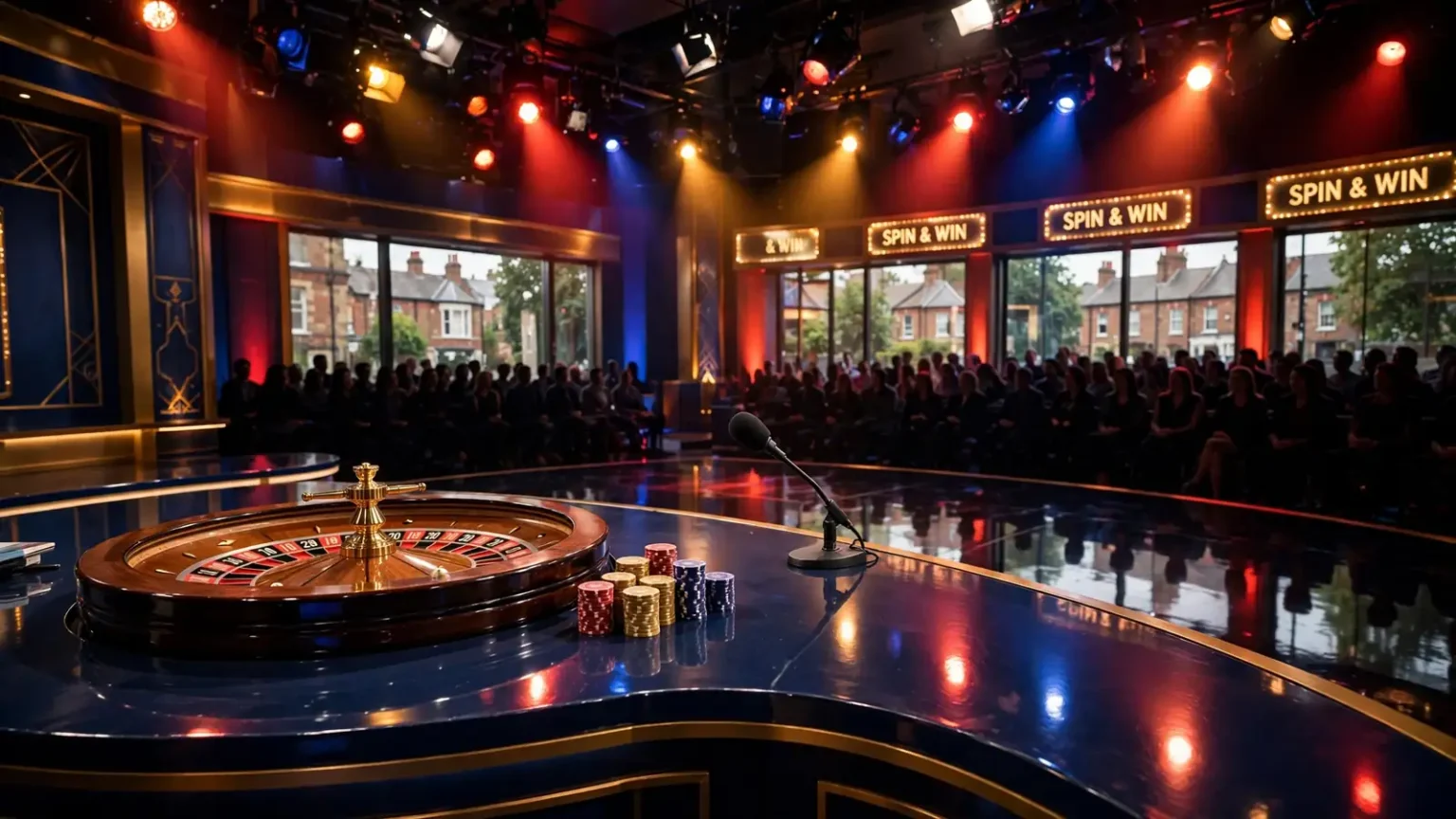
A game-show label alone does not establish a game’s presentation, availability, operator, or regulatory status in the UK.
What the Evidence Establishes About Online Casino Game Shows
“Online casino game show” is a descriptive phrase, not a sufficient basis for identifying a particular gambling product, operator or regulatory status. It brings together two ideas: a casino setting and a show-style presentation. The phrase alone does not establish which games fall within it, how any particular game is presented, or where it can be played. Those distinctions matter when assessing claims about the category in the United Kingdom.
The relevant regulatory framework concerns gambling activity and the businesses that provide it, rather than a label used to describe a style of game. The UK Gambling Commission oversees commercial gambling in Great Britain and is the sole regulator for that activity there. Its remit includes remote gambling offered to consumers in Great Britain, even where the equipment used to provide the service is located elsewhere. Online casino activity therefore cannot be assessed solely by considering a product’s name or presentation: the operator and the service offered to customers also matter.
New Online Casino Sites UK: Amatic Games Explained
The Commission issues operating licences to businesses and personal licences to individuals who carry out regulated roles. These are different forms of authorisation. An operating licence concerns the business providing gambling services; a personal licence concerns an individual working in relevant operational roles. A phrase such as “live casino game show” does not itself reveal which business holds an operating licence or whether a named individual holds a personal licence. Those are questions about the parties and activities involved, not about the wording used to describe a game.
This distinction sets a useful boundary for the subject. The broad category can be discussed as a type of casino-related search topic, but that does not make every item described with similar language interchangeable. A product name, an operator’s catalogue, a particular presentation format and the legal status of a gambling service are separate matters. Evidence about one of them does not automatically establish the others. A title appearing in promotional wording, for example, would not by itself show which company provides the gambling service or under what regulatory arrangement it is offered.
No-Limit Online Casinos in the UK: Rules Explained
The same care applies to the word “best”. A ranking requires a defined basis of comparison. Depending on the purpose, that might involve verified information about a product’s rules, its availability, a feature of its presentation, or the operator providing it. The term alone does not specify which measure is intended. Without a stated and supported criterion, “best” is a value judgement rather than a factual classification. An assessment of the category should therefore avoid presenting a ranking as though the phrase itself identifies a settled set of products or a measurable standard.
The regulatory context offers a firmer point of reference. In Great Britain, remote gambling supplied to consumers falls within the Commission’s remit regardless of where the relevant equipment is physically situated. This means that the location of servers or other key equipment does not, by itself, take a remote gambling service outside the framework. The relevant focus is the gambling activity offered to consumers in the market and the business responsible for offering it. A description of a game as a show, live, online or casino-based does not replace that analysis.
The distinction between Great Britain and the United Kingdom also deserves precision. The Commission is the sole regulator for commercial gambling in Great Britain, and its remit covers the remote gambling described above. The framework should not be expanded by careless wording into a claim about every part of the United Kingdom. In particular, a statement about the Commission’s role in Great Britain should not be recast as though the same statutory arrangement necessarily applies uniformly across the whole country. That geographical distinction is relevant whenever a broad UK label is used in connection with gambling regulation.
Attention: A descriptive phrase like "live casino game show" does not identify the licensed business responsible for the service or the regulatory status of the operator.
For the same reason, regulatory claims should be attached to the correct subject. A provider, an operator, an individual employee and a game are not the same thing. The Commission’s operating licences are issued to businesses, while personal licences apply to individuals in relevant roles. A game’s descriptive category does not itself hold an operating licence. Nor does the presence of a particular style of game establish which licensed business is responsible for making it available. Identifying the responsible operator is therefore a separate question from deciding whether a product fits an everyday description of a casino game show.
The word “live” can also be read in more than one way in ordinary descriptions. It may be used as part of a product label or as a description of presentation, but those uses do not establish the technical or operational details of a particular offering. In regulatory terms, the material point is whether remote gambling is being offered to consumers in Great Britain and which business is responsible for that service. The label does not settle those matters. Nor should it be treated as proof of any particular game mechanic, host arrangement or method of interaction.
Likewise, “game show” should not be treated as a regulatory category simply because it appears in a casino context. The regulatory facts establish oversight of gambling activity and the licensing roles of businesses and individuals. They do not make the wording used in a product description a substitute for identifying the activity and the responsible parties. The phrase can help describe the subject under discussion, but legal status follows from the service and its provision, not from a marketing label alone.
Amatic Games at UK Online Casinos: How They Reach Lobbies
These distinctions help keep several questions separate. One concerns what the general term means in ordinary use. Another asks which operators make particular products available. A further question concerns a named title, while another concerns how a live presentation is organised. The answers require different kinds of evidence. A general description cannot establish operator availability; a list of operators would not, by itself, explain a format; and a title alone would not establish the regulatory position of the service through which it is offered.
The same principle applies when interpreting claims about a “casino” in this context. The Gambling Act 2005 defines a casino as an arrangement that gives people an opportunity to participate in one or more casino games. That definition focuses on the arrangement and the opportunity to participate, rather than on a particular visual style or title. It provides a legal reference point for the word “casino”, but it does not classify every show-like online product in detail. The practical classification of an offering still depends on what is provided and by whom.
The distinction between commercial oversight and product description is not merely technical. It prevents a category label from being mistaken for evidence about consumer access, responsibility or authorisation. The Commission’s role is to regulate gambling activity in its remit and to issue licences to businesses and individuals. That role does not mean that every phrase used in connection with online casino entertainment corresponds to a separate licence class. A description can be useful for identifying a topic without answering the questions that determine who is legally responsible for providing gambling.
Do
- Separate descriptive language from verification
- Use regulatory facts to identify the Commission’s remit
- Treat labels as topics for discussion
Don’t
- Use broad phrases as proof of specific games
- Treat marketing labels as regulatory classifications
- Mistake a category label for evidence of authorisation
The term points to a subject area, but it does not independently establish a definitive inventory, a quality ranking, the availability of a named product, or the mechanics of a presentation. Those claims need evidence directed to each question. Regulatory context can clarify the responsibilities and geographic scope involved, but it cannot be used to fill in product-level detail that the label itself does not provide.
The most reliable starting point is consequently to separate description from verification. Descriptive language identifies what a discussion is about; it does not prove the details of an individual offering. Regulatory facts identify the Commission’s remit and the distinction between business and personal licences; they do not amount to endorsements or product classifications. Keeping these levels apart allows the category to be discussed without treating a broad phrase as proof of specific games, operators or features.
Top online casinos in the UK
- SpinFormulaBonus: 550% Up To £15,000 + 550 FS · Payout speed: 1-3 business days
- AmunbetBonus: Join now and get 450% up to 2,700 GBP + 450 FS · Payout speed: 1-3 business days
- NightWinBonus: £900 + 400 free spins · Payout speed: 1-3 business days
- NightLuckBonus: Welcome Pack + 805% Up To 6400€ + 280 FS · Payout speed: 1-3 business days
- DieselwinBonus: Welcome Pack 250% up to £4000 + 200 FS · Payout speed: 1-3 business days
- BritsinoBonus: Welcome Package – Get your £2,200 + 2,000 FS · Payout speed: 1-3 business days
- WinBeastBonus: €5000 + 500 FS + €650 Freebet · Payout speed: 1-3 business days
- EvoSpinBonus: 125% up to €2500 + 125 Free Spins · Payout speed: 1-3 business days
- JetsetspinsBonus: 200% Bonus + 100 Free Spins + Free Royal Wheel · Payout speed: 1-3 business days
- BeOnBetBonus: 100% up to €500 + 100 FS · Payout speed: 1-3 business days
Casino Availability and the Limits of the Verified Information
Whether an online casino offers live game shows is an operator-level question. It cannot be answered merely by establishing that a casino is licensed, that it offers live gambling, or that a particular kind of game exists elsewhere in the market. Availability has to be tied to a specific operator and to a current catalogue.
This distinction matters in the United Kingdom, where commercial remote gambling is regulated at operator level. Businesses serving customers in Great Britain must hold the relevant UKGC licence, regardless of where their equipment is located. The Gambling Commission issues operating licences to businesses and personal licences to individuals in relevant roles; it is the sole regulator for commercial gambling in Great Britain. These regulatory facts establish who may offer gambling lawfully, but they do not establish which titles appear in any one operator’s lobby.
IGT Online Casinos UK: Amatic Supplier Guide
A licence and a catalogue answer different questions. The licence concerns the operator’s authority to provide regulated gambling. A catalogue listing concerns the games that operator makes available. One cannot be substituted for the other: a UKGC licence does not, by itself, confirm that a casino carries a particular live game show. Equally, a title appearing in a search result or in a general description of a provider’s products does not establish that the title can be played through a particular UK-facing casino.
Why availability needs operator-specific evidence
A statement that a casino offers a game show needs to identify the operator and the relevant title, and to be supported by information that actually connects them. Evidence about a provider’s wider catalogue, or about live gaming in general, does not establish that connection. Nor does a casino’s broad description of its services necessarily show that a particular title is included.
The distinction is especially important for pages that present recommendations or rankings. Calling an operator one of the best places to find live game shows implies that its relevant catalogue has been checked and compared. A ranking also suggests that the basis for comparison is known. Without evidence about the titles available and the criteria used to assess them, such a ranking would be unsupported. A list should therefore be limited to operators for which the relevant availability can be demonstrated, rather than assembled from general descriptions of the UK casino market.
A ranking of the best places for live game shows implies that a specific operator’s current catalogue has been checked and compared against defined criteria.
Availability is also a time-sensitive claim. A catalogue can change, and a listing captured at one point should not automatically be treated as a permanent feature of the operator. A sound description should make clear what was checked and when, particularly if it names a casino as a current destination. A historic reference may establish that a game was listed at some earlier point; it does not necessarily establish that the same game remains available now.
The same care applies to distinctions between a casino’s overall offering and the games accessible to a particular customer. A game may appear in an operator’s general catalogue without being available in every account context, or it may be listed differently across the operator’s pages. Unless the evidence establishes the relevant availability, broader claims about access should be avoided. The central question remains narrow: is the named title currently offered by the named UK-facing operator?
What UK regulation can establish
The UK regulatory framework provides a basis for assessing the status of an operator, not for inferring its game selection. Online gambling in the UK is lawful when provided by a properly licensed operator, and businesses offering real-money gambling to customers in England, Scotland and Wales must hold a UKGC licence. The Gambling Act 2005 governs gambling in England, Wales and Scotland, while Northern Ireland has a different legal framework. These points help distinguish regulated provision from offshore provision, but they do not supply a catalogue of live game shows.
Amatic Casinos UK: Games, Licensing and Bonuses
Remote gambling operators selling into the British market are subject to UK licensing requirements even if their key equipment is based elsewhere. An offshore location does not remove that obligation when the service is offered to consumers in Great Britain. Offshore casinos operating outside the UKGC system do not hold a UKGC licence, and their presence on the internet should not be confused with lawful, locally regulated availability.
For a UK-facing casino, the relevant regulatory check is therefore separate from any check of its games. The Gambling Commission’s Public Register can be used to assess an operator’s licence status. That register is not a record of every game in a casino lobby. A licence entry cannot be treated as confirmation that the operator carries live game shows, just as a game listing cannot stand in for confirmation that the operator is properly licensed.
This separation prevents two different kinds of overstatement. One is to infer that a casino offers a specific product because it is licensed. The other is to treat a casino’s product page as sufficient proof of its regulatory status. Neither inference follows. Operator status and game availability require their own evidence.
Regulatory Status
Offshore casinos operating outside the UKGC system do not hold a UKGC licence and should not be confused with lawful, locally regulated availability.
How to assess a casino claim
A reliable availability claim should be specific enough to be checked. It should identify the operator, name the relevant game or category, and rest on a current operator catalogue or another sufficiently clear record of the operator’s offering. General statements such as “this casino has live games” are not equivalent to evidence that it carries live game shows. Nor does a provider’s general association with a casino prove that every product in that provider’s catalogue is available there.
The wording of a claim should match the strength of the evidence. If an operator’s current catalogue names a specific title, it may support a statement about that title. If the only evidence describes the casino’s live offering broadly, the description should remain broad. If the evidence concerns an earlier catalogue, the claim should be dated rather than presented as current. These limits are not merely formal: they help prevent an old or incomplete listing from being turned into a present-day recommendation.
A comparison between casinos requires more than establishing a single listing for each one. The basis of comparison needs to be visible. For example, the evidence would have to support the particular features being compared, rather than relying on adjectives such as “best”, “leading” or “largest”. Those terms make evaluative claims. Without a defined and evidenced basis, they do not tell the reader which operators have confirmed availability or why one should rank above another.
Wazdan Casinos in the UK: Games and Licensing
The same standard applies to statements about absence. A search that does not return a title is not, on its own, proof that the operator does not offer it. The title might be listed under a different name, placed in a different section, or omitted from the page being examined. A defensible claim about absence needs a defined scope of checking.
Availability is not the same as suitability
Confirmation that a casino carries a game does not amount to a recommendation. Availability describes an operator’s catalogue; suitability would require a separate assessment of factors such as licence status, terms and responsible-gambling arrangements. In Great Britain, UKGC-licensed operators must prompt customers to set a financial limit before their first deposit, and reductions to a limit must be applied immediately. GamStop has been mandatory for all GB-licensed online operators since 31 March 2020. These requirements concern operator obligations and customer protections, not the content of a game catalogue.
The distinction also prevents a catalogue listing from being used as a proxy for compliance. A game’s presence does not show that every obligation applying to the operator has been met. Conversely, compliance with regulatory requirements does not confirm that a particular show is offered. Each statement needs evidence appropriate to the subject it addresses.
For the same reason, a general reference to a casino’s live section should not be treated as a complete account of what it offers. A broad category label may tell little about the individual products within it. Naming a specific game requires evidence at that level. Naming a casino as a destination for a category requires evidence that the category is actually present in its current offering.
Assessment Criteria
- Operator authorisation is a regulatory question
- Game availability is a current catalogue question
- Recommendations are evaluative questions
- These three matters should not be collapsed into a single claim
A restrained account of the UK market
For the UK market, the most defensible account separates three matters: whether an operator is authorised to serve customers in Great Britain, whether its current catalogue lists the relevant live game show, and whether any wider recommendation is supported by stated criteria. The first is a regulatory question, the second a current availability question, and the third an evaluative question. They should not be collapsed into a single claim.
This approach also avoids implying that every licensed casino has the same catalogue. A shared regulatory framework does not mean that operators provide identical games. Nor does the existence of a game in the wider market establish its presence at every licensed site. A casino-by-casino list is only useful when each entry can be connected to a current, operator-specific record.
Accordingly, claims about online casinos offering live game shows in the UK should be made at the level the evidence supports. Where a named operator and title are confirmed by current information, that relationship can be stated plainly. Where only the operator’s licensing position is established, the statement should remain about licensing. Keeping those claims separate gives a more accurate account of casino availability than an unsupported list or a ranking presented without a verifiable basis.
Crazy Time and Funky Time: What Can Be Verified
Crazy Time and Funky Time are distinct names, but a name alone does not establish what a product offers. It cannot confirm who provides it, what rules apply, whether the title is currently available in Great Britain, or whether a particular casino carries it. Those are separate questions, each requiring evidence tied to the relevant product and operator.
Betsoft Casinos in the UK: What to Check
The distinction matters because a familiar title can appear in descriptions, promotional material or third-party listings without those sources establishing the same facts. A listing may identify a name without documenting its current status. A promotional description may summarise a product but is not, by itself, evidence of the rules that govern a session. Claims about the provider, features or availability therefore need to be connected to an identifiable, current source rather than inferred from the title.
What the names establish—and what they do not
The names identify the subjects under discussion; they do not supply a reliable basis for describing either one’s gameplay. In particular, the word “live” in a description should not be treated as proof of any specific production arrangement, interaction or set of rules. Likewise, the word “game show” does not, on its own, establish how a product works or how outcomes are determined.
This is not a distinction unique to these titles. Product names and category labels are useful for finding material, but they are not substitutes for terms, rules or product information. A comparison between Crazy Time and Funky Time would need evidence that addresses both on a like-for-like basis. Without that, claims that one is faster, more interactive, more generous or otherwise preferable would be unsupported. The names themselves provide no measurable basis for ranking them.
Crazy Time
A distinct product name that identifies the subject but does not independently establish rules, provider, or current GB availability.
Funky Time
A distinct product name that identifies the subject but does not independently establish rules, provider, or current GB availability.
The same caution applies to claims about a title’s provider or status. A casino lobby entry or a third-party description may use a name, but the name alone does not establish the commercial relationship behind it. Nor does it show that an item listed elsewhere is currently accessible in a particular setting. These are matters of verification, not conclusions that can be drawn from wording.
The regulatory context
For Great Britain, the legal position of a gambling operator is distinct from the identity of a game title. Remote gambling offered to consumers in Great Britain must be covered by the relevant UKGC licence, regardless of where the operator’s key equipment is located. The Gambling Commission regulates commercial gambling in Great Britain and issues operating licences to businesses. A title’s familiarity or branding does not establish that an operator has the required licence.
This distinction also limits what can be inferred from the presence of a product name. A product label does not itself confer regulatory status, and it should not be treated as evidence that a gambling service is authorised for the British market. The legal question concerns the operator and its licensed activity, rather than whether the title appears in a description or is discussed elsewhere.
For readers comparing references to Crazy Time and Funky Time, the reliable approach is therefore to keep separate claims separate: the identity of the title, the nature of the product, the operator offering it, and the operator’s regulatory position are not interchangeable facts. Evidence for one does not automatically establish the others.
Amatic Casinos in the UK: Games and Availability
Why precise descriptions matter
Unqualified descriptions can create a misleading impression even when they repeat familiar language. Calling a title a live casino game show, for instance, may sound like a complete description while leaving essential questions unanswered: what exactly is being described, which version or service is meant, and what documentation supports the claim? A concise label can be useful, but it should not carry more meaning than its evidence permits.
The same standard applies to comparisons. Statements that Crazy Time and Funky Time share particular mechanics, differ in a defined way, or have a particular relationship require direct support. Similarity between names, or their appearance in the same broad category, is not proof of shared rules, providers or features. Without evidence that addresses those points, a comparison would turn assumptions into apparent facts.
Accordingly, the titles can be discussed as separate named subjects, but details should be attributed only when a suitable source supports them. Product documentation is relevant to rules and features; operator information is relevant to the service through which a product is offered; and regulatory records are relevant to licensing. Keeping those evidential roles distinct avoids treating a name as proof of matters it cannot establish.
The Live Casino Game Show Format
The phrase “live casino game show” combines a presentation label with a gambling setting, but it does not by itself establish the rules or mechanics of a particular product. “Live” may describe how an experience is presented, while “game show” may suggest a relationship to entertainment formats. Neither term is enough to determine whether a product uses a host, a studio, a streamed presentation, a wheel, rounds, audience participation or any other feature. Those details require product-specific evidence.
Legal Definition of a Casino
The Gambling Act 2005 defines a casino as an arrangement that gives people an opportunity to participate in one or more casino games, focusing on the arrangement rather than visual style.
This distinction matters because a format description is not a rulebook. The label alone cannot show how an outcome is generated, what a participant must do, how a prize is calculated or whether a particular experience is available to people in Great Britain. It should not be treated as proof that two products with similar names or promotional language share the same mechanics. Nor does the label establish that the experience is a casino game in the legal sense.
The Gambling Act 2005 defines a casino by reference to an arrangement that gives people an opportunity to participate in one or more casino games. That legal description does not define a separate category called a game show, or specify what its presentation must look like. The boundary between entertainment language and a gambling product therefore depends on the actual arrangement, not simply on the wording used to market it.
In Great Britain, the relevant regulatory question is whether a business offers remote gambling to consumers there. Such an operator must hold the appropriate UKGC licence, wherever its key equipment is located. The Gambling Commission regulates commercial gambling in Great Britain; Northern Ireland is outside the scope of the Gambling Act 2005. These rules apply to the operator’s activity, rather than supplying a description of how a live show-style game is staged or played.
A product’s presentation should also be kept separate from the responsibilities attached to the account through which real-money gambling is offered. UKGC-licensed operators must make GamStop available, and must prompt customers to set a financial limit before the first deposit. If a customer lowers that limit, the change must take effect straight away. These are operator-level protections; they do not demonstrate that any particular game show has a specific format or control built into its rounds.
Amatic Online Slots at UK Casinos: Games and Formats
The same distinction applies to bonus conditions. The Gambling Commission’s cap on wagering requirements for bonus funds is 10×. That rule concerns the terms attached to bonus funds, not the mechanics of a show-style game. A presentation may be described as a game show, but the phrase alone gives no basis for inferring whether a bonus applies, how winnings are treated, or what conditions govern a promotion. Those matters depend on the relevant operator’s published terms.
Online slot rules should not be transferred automatically to every product carrying game-show language. In Britain, online slots cannot offer autoplay and must leave at least 2.5 seconds between spins. The maximum stake per game cycle is £5 for players aged 25 and over, and £2 for those aged 18 to 24. These requirements concern online slots. Without evidence that a particular game-show-style product is an online slot, those rules cannot be used to describe its interface or gameplay.
Barcrest Online Casinos in the UK: Evidence Check
Accordingly, a reliable description of a specific live game show would need to identify the product and establish its rules from suitable product information. A broad category label cannot support claims about hosts, studios, interaction, pacing, random outcomes, prize structure or game controls. Nor can it establish which UK-facing operators carry the product. Those are separate factual questions, not properties that follow from the words “live” or “game show”.
At the format level, the careful conclusion is limited: the term signals a style of casino presentation, but it does not define a uniform set of mechanics. Regulatory requirements can be stated for licensed remote gambling and for the specific product types covered by particular rules. They cannot fill in the unestablished details of a show’s design. A description that goes further than the available product evidence risks turning an appealing label into an unsupported account of how gambling takes place.
What is the new UK slots stake limit, and how does it affect Amatic games?
The limit is £5 per game cycle for players aged 25 and over, and £2 for players aged 18 to 24. It applies to online slots, including Amatic titles offered by UK-licensed operators.
What bonuses and free spins are available at Amatic casinos in the UK?
Amatic is a software supplier, not a casino, so the operator sets the bonus terms. 32Red, Betfred and bet365 offer free-spin wins with no wagering requirement; bet365 requires a £10 minimum lifetime deposit and distributes up to 500 spins over 10 days.
How does the UK’s 10× wagering cap affect Amatic casino bonuses?
Since 19 December 2025, wagering requirements on bonus funds at UK-licensed operators cannot exceed 10 times the bonus amount. The rule applies to bonuses at operators offering Amatic games; the operator sets the specific offer terms.
Must a casino be Gambling Commission-licensed to offer Amatic slots to UK players?
For consumers in Great Britain, the responsible casino operator must hold the relevant UK Gambling Commission operating licence. Amatic’s software licence does not replace the operator’s licence.
Are Amatic casinos on GamStop?
Amatic does not operate consumer-facing casinos. All online operators licensed in Great Britain have been required to participate in GamStop since 31 March 2020.
Material created by the team Kassu


